Hyperopia, also known as farsightedness, causes unclear (blurry) vision when you try to focus on a close-by object. For instance, blurry vision while reading a book, etc. Eye strain during close-up tasks and headaches are common symptoms of hyperopia.
Corrective measures include prescription eyeglasses, contact lenses, or vision correction surgery. If you notice any vision changes, visit a trusted ophthalmologist, who will assess your eyes, diagnose your condition, and give you proper guidance towards the best course of treatment/management for you.
What is Hyperopia / Hypermetropia / Farsightedness
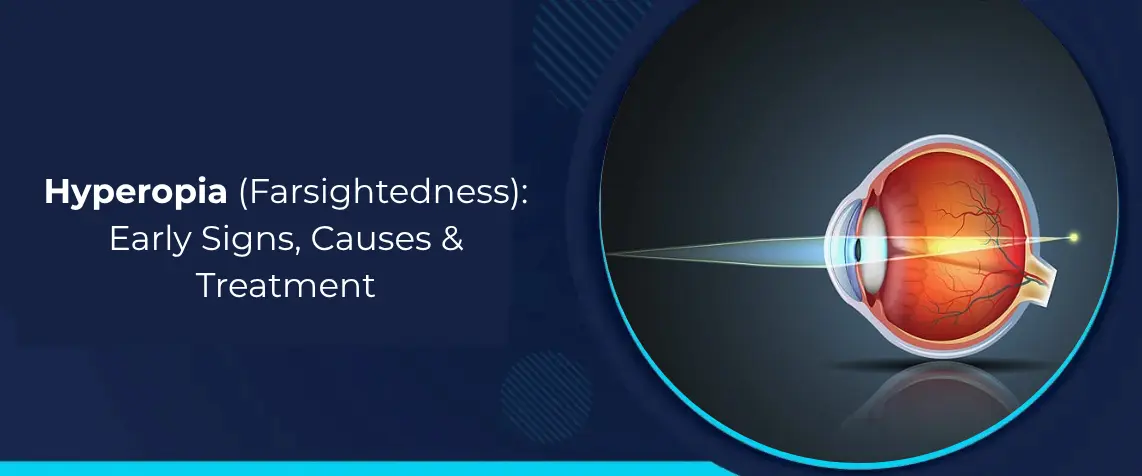
Hyperopia or farsightedness is diagnosed when the shape of the eye is shorter than usual or if the cornea (the outermost, clear layer of the eye) has a flatter curve than normal. This causes the light entering the eye to bend incorrectly and focus at a spot behind the retina instead of directly on it. This results in blurry near vision.
| ⚠️ Rest assured, Hyperopia, like all other refractive errors, is NOT a disease. It is a common eyesight issue that can be corrected through various management strategies. You do not need to stress too much about it being a “disease” or finding a “cure” before it progresses further. However, effective correction strategies should be employed for comfortable vision. |
Objects closer to you (for eg: your phone or a book) may appear unclear, while objects farther away (for eg: a billboard or movie theater) may appear completely clear.
Most people generally have bilateral hyperopia, meaning both eyes are affected. However, having hyperopia in just one eye is also a possibility.
Hyperopia Symptoms
The first and most obvious symptom is blurry near vision. Objects within 6 metres may start to appear blurry at the time of onset. You will notice significantly clearer vision (while looking at the same objects) from farther away.
- Not every person with hyperopia will notice symptoms. In fact, in cases of mild hyperopia, there may be no noticeable symptoms at all. While moderate hyperopia can cause significant discomfort during daily tasks.
Hyperopia can put more strain on your eye muscles, making them work harder than usual to focus on objects. This can, in turn, lead to other signs such as:
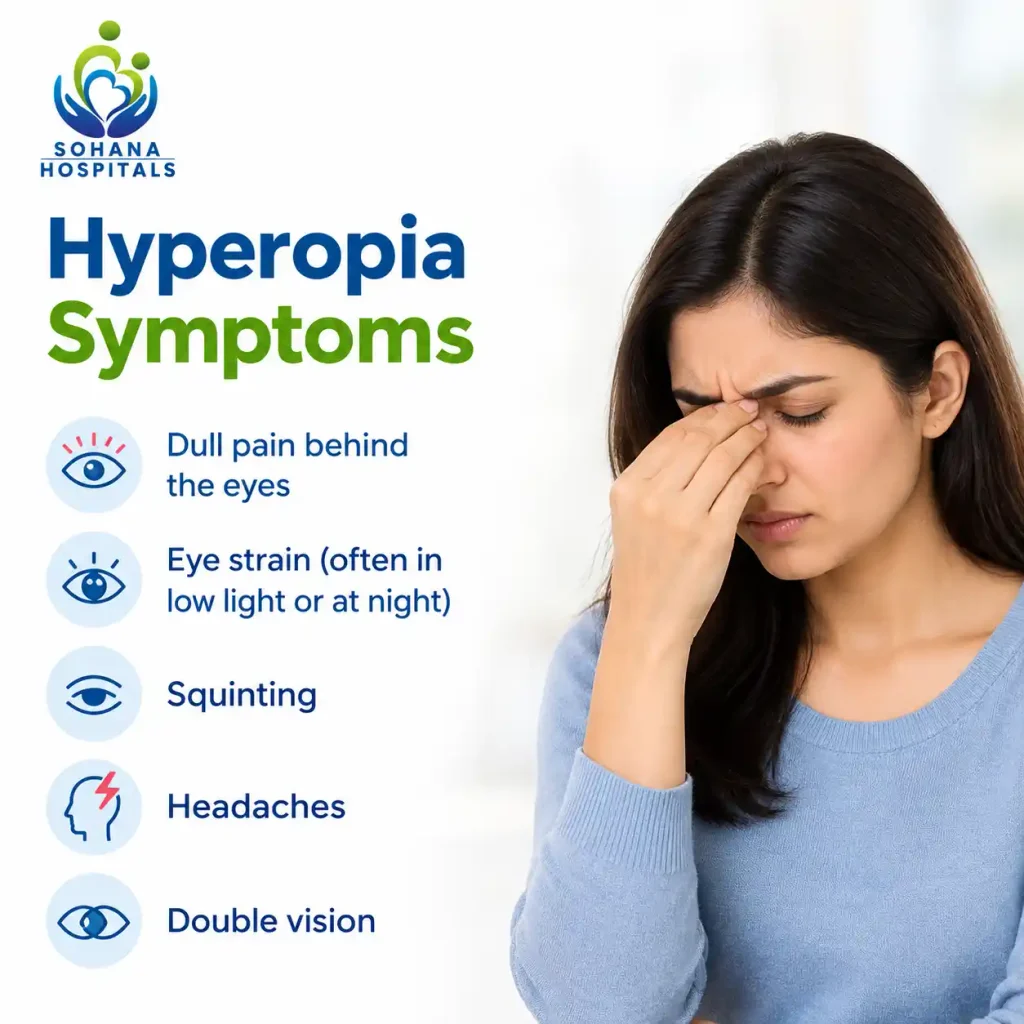
- Dull pain behind the eyes: A dull ache behind your eyes after focusing on close-up tasks.
- Eye strain (often in low light or at night): Most often experienced during close-up tasks at night or in low light. Your eyes may feel fatigued as they have to work harder to focus on close-by objects.
- Squinting: A natural response to unclear vision, you may notice yourself squinting more often to be able to see clearly. Squinting can sometimes provide slightly clearer vision as the action alters how the light enters your eyes.
- Headaches: Headaches are very commonly associated with uncorrected refractive errors. The extra work your eyes have to put in can lead to temporary headaches.
- Double vision: Although not a common symptom, some people with hyperopia report double vision, i.e., seeing two distorted, overlapping images of an object instead of one fused, clear image.
🚨 Infants and young children may not be able to communicate their vision issues to you. This is why, if you notice your child rubbing their eyes, squinting more than usual, acting unamused by their favourite toys, books, etc., schedule an eye checkup with an expert paediatric eye doctor at the earliest.
Hyperopia causes
There are two primary reasons for hyperopia:
- Shorter axial length: This is when your eyeball’s shape is shorter than the standard size, from front to back.
- Flat corneas: This is when your corneas are slightly flatter than usual. This causes the light entering the eye to hit a spot behind your retina instead of on it.
| 💡 DID YOU KNOW? Hyperopia can be inherited genetically, meaning that if parents have the condition, the child has a higher possibility of being predisposed to develop it too. (via NIH)[1] |
Hyperopia Treatment & Management Options
The most common forms of treatment or management strategies include:
- Prescription glasses or contact lenses: Once diagnosed with hyperopia, your doctor will likely prescribe eyeglasses or contact lenses according to your eye power. These visual aids help correct the way light bends when it enters your eyes, facilitating clear near vision.
- Vision correction surgery: If you want a more permanent solution, you can speak to your doctor regarding your specs removal options. There are many vision correction treatments suited for hyperopia, including Contoura Vision, PRK, PRESBYOND, and ICL. Your doctor will evaluate your eyes before advising which procedure would be the most suitable for you.
Conclusion
If you notice any of the above-mentioned signs and symptoms in your own or a loved one’s vision, seek professional help from the best eye doctors at Sohana Hospital. The institution boasts a vast team of highly experienced ophthalmologists, who assess your unique eyes, give a proper diagnosis, and advise the best possible course of management for your refractive errors.
If you wish to eliminate the need for glasses altogether, Sohana Hospital is the region’s 1st & ONLY hospital with a Complete Refractive Suite – all advanced specs removal technologies under one roof!
Reference Sources:
- National Institutes of Health. Hyperopia. https://www.ncbi.nlm.nih.gov/books/NBK560716/#:~:text=Though%20sporadic%2C%20few%20genetic%20factors%20have%20been%20identified%20in%20association%20with%20hyperopia. – August 25, 2023