Contoura Vision and LASIK surgery (or laser-assisted in situ keratomileusis) are two common types of specs removal surgeries. In both treatments, the cornea (clear, outer layer of the eye) is reshaped in order to focus light correctly on the retina, resulting in clear vision.
Before selecting a surgery, it is important to acquaint yourself with the key features of and differences between available techniques, so you can make an informed choice. That being said, your eligibility for a specific type of vision correction surgery depends on several factors, such as your cornea’s thickness, your refractive error (specs power), etc.
In this blog, we are going to familiarise you with the differences between Contoura Vision and conventional LASIK surgery, along with their benefits.
What is Contoura Vision Surgery?
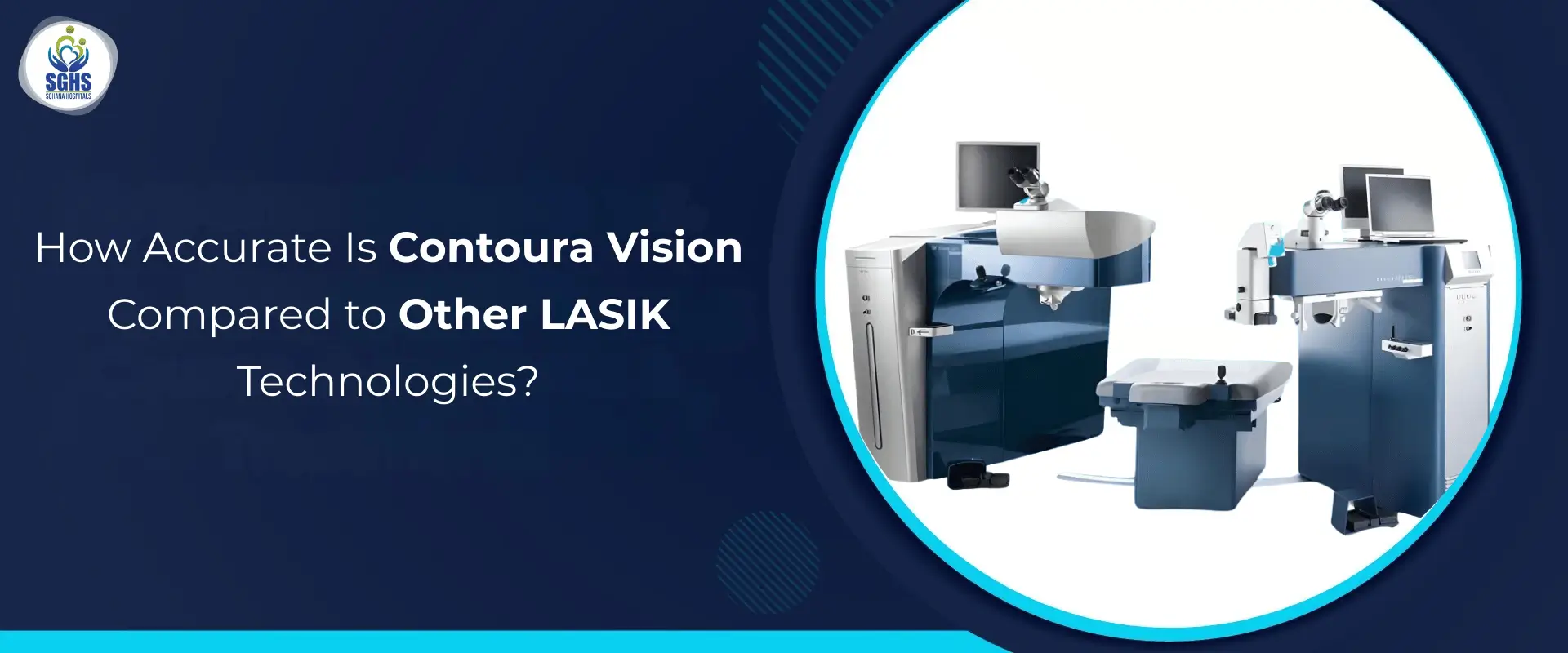
Contoura Vision is a topography-guided LASIK surgery that corrects complex refractive errors like myopia (nearsightedness), hyperopia (farsightedness), and astigmatism (distorted vision). The surgery is approved by the US-FDA, meaning it meets global standards of safety.
Contoura Vision maps 22,000 elevation points on your eye, measuring the eye’s surface in detail. This allows for not just the identification of refractive errors but also subtle corneal irregularities that impact everyday vision.
Next, a corneal flap is created using a femtosecond laser instead of a mechanical blade. The cornea is then reshaped with the help of an excimer laser.
Key Differences Between Contoura Vision and Traditional LASIK Surgery
Both Contoura Vision and LASIK have been widely used to correct refractive errors and facilitate crystal clear vision. However, their differences make them stand as two very different options.
Corneal Mapping
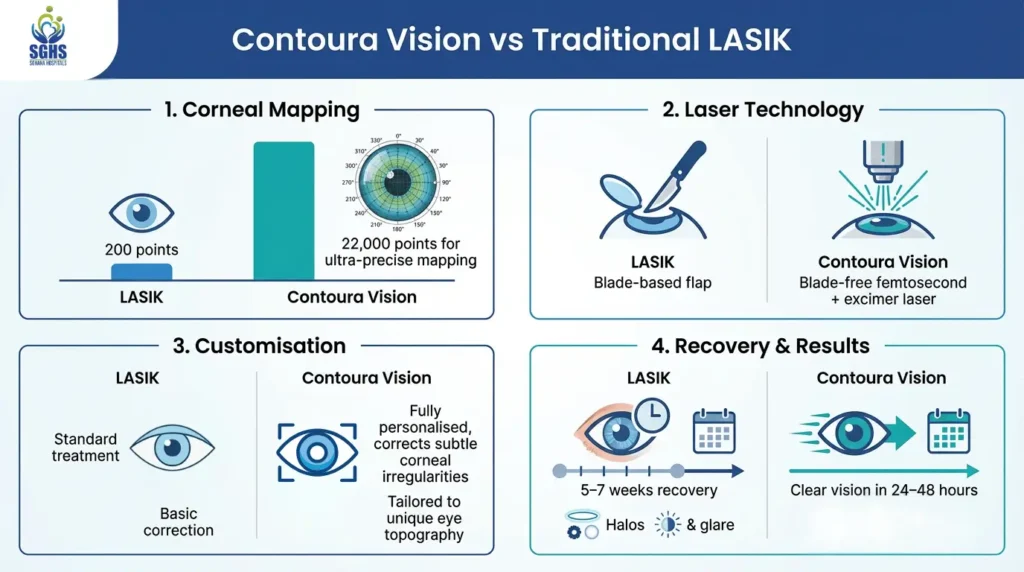
You can think of corneal mapping as clicking a photo of your cornea. While conventional LASIK takes approximately 200 points into account, Contoura Vision captures an impressive 22,000 points.
So essentially, the difference between Contoura Vision and LASIK can be likened to the difference between a high-resolution professional camera and a basic digital camera. The more detailed the capture, the better the final outcome.
The topography-guided mapping technology helps create a precise map of the eye, taking into account both – major vision issues and subtle imperfections. This allows your surgeon to understand your eye’s unique requirements and address them accordingly.
Laser Application
The key difference in the laser application in both surgeries is that Contoura Vision uses a femtosecond laser for creating a precise corneal flap and then reshapes the cornea with an excimer laser. Whereas conventional LASIK employs a mechanical or manual blade for the flap creation process.
A flap created using a femtosecond laser (as in Contoura Vision) leaves no room for human error; it is more precise, accurate, and much safer.
Customisation
Contoura Vision offers high-level customisation as it measures 22,000 points on your eye. It then treats your eyes according to your unique visual requirements. It creates a map of your eye’s features, develops a customised treatment plan, and uses precise laser application according to the surgical plan.
This allows for the correction of vision problems that conventional LASIK does not address. Conventional LASIK cannot examine your eye’s unique surface as Contoura Vision does; therefore, it does not identify or correct subtle corneal irregularities. LASIK only corrects your refractive errors through a standard treatment approach.
Contoura Vision Recovery Time vs. LASIK Recovery Time
Since Contoura Vision is an advanced form of LASIK, it offers a much faster recovery than traditional LASIK. The surgery also results in little to no post-op side effects (halos, glare, starbursts, etc.) as it treats corneal aberrations that lead to them. Immediate visual recovery after Contoura Vision takes 24-48 hours, with vision stabilising further and becoming increasingly better in the following weeks.
The Contoura Vision recovery process comes with minimal discomfort in comparison with recovery after LASIK. Conventional LASIK comes with a longer recovery time. It takes approximately 5-7 weeks for complete recovery.
Conclusion
If you have been thinking of getting your specs removed and have been looking at available surgery options, Contoura Vision might just be the best decision for your vision! Sohana Hospital offers Contoura Vision, among other advanced specs removal treatment options.
Let’s review Contoura Vision benefits one last time:
- Maps 22,000 elevation points on the eye
- Personalised to your unique visual requirements
- Bladeless and painless
- 10-minute procedure
- Corrects myopia, hyperopia, astigmatism, and corneal irregularities
- Quick recovery
- No hospital stay
Sohana Hospital boasts the most advanced diagnostics and treatment with a focus on high-quality patient care. A team of highly skilled, expert eye specialists, and support staff guide you through every step of your specs removal journey at the best eye hospital for LASIK in Mohali.
The institution maintains the highest level of professionalism and follows stringent protocols to provide safe and ethical services. Additionally, to make vision correction more accessible, the hospital also offers no-cost EMI options, so you can ditch your specs without financial worries.
So, why wait? Visit Sohana Hospital for Contoura Vision screening tests today!