LASIK or Laser-Assisted in Situ Keratomileusis is one of the most widely used ways for permanent vision correction. It involves reshaping the cornea to facilitate clear vision without the need for specs or contact lenses.
In this blog, we are going to go over some of the most common types of LASIK surgery, along with their features and benefits.
Read more on:
ToggleTypes of LASIK
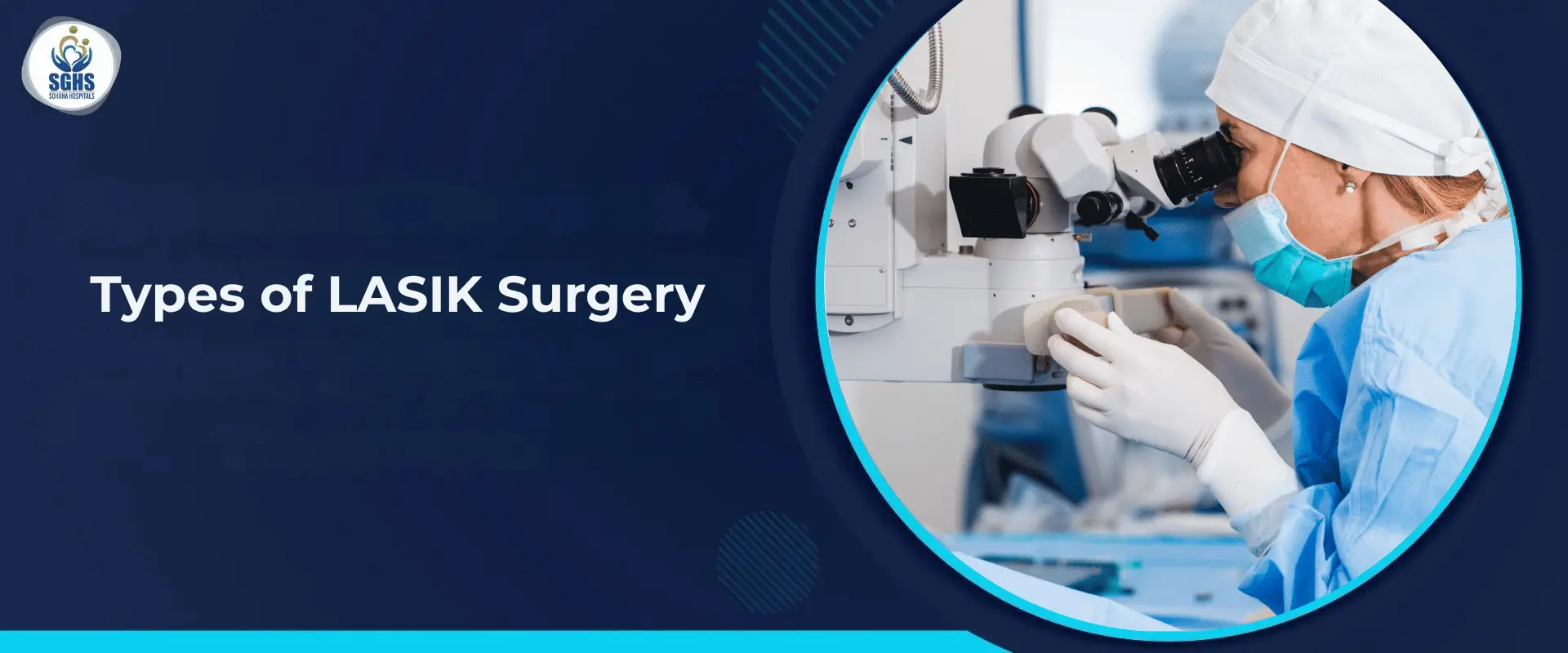
There are multiple types of LASIK surgeries, each designed to give you permanent, clear vision. The “best type of LASIK” differs for every patient, owing to unique refractive errors, visual requirements, and overall health.
The different types of LASIK eye surgery include:
- Conventional LASIK
- Bladeless (Femto) LASIK
- Wavefront-Guided LASIK
- Topography-Guided LASIK
- PRK
- SMILE
Conventional LASIK Surgery
Conventional LASIK involves creating a flap in the cornea with a mechanical blade (microkeratome). Once a flap is created, lifted, and placed to the side, the corneal tissue is reshaped using an excimer laser. Once reshaped, the corneal flap is positioned back in place. This procedure effectively corrects myopia, hyperopia, and astigmatism.
| FEATURE | DETAILS |
| Flap creation | Yes (microkeratome blade) |
| Pain | No |
| Procedure time | 20 minutes |
| Corrects | Moderate refractive errors (myopia, hyperopia, astigmatism) |
| Recovery time | 1 week |
| Complications | Common (dry eyes, halos, glare, starbursts around light; may take a few months to clear up) |
Bladeless LASIK
Bladeless LASIK (e.g., Femto LASIK), as the name suggests, does not use a blade to create the corneal flap. Instead, a femtosecond laser is employed to create the incision. This delivers a much safer and more precise flap creation, shortening recovery time and post-op complications. Then an excimer laser is used to reshape the cornea, thereby correcting vision.
| FEATURE | DETAILS |
| Flap creation | Yes (femtosecond laser) |
| Pain | No |
| Procedure time | 10-15 minutes |
| Corrects | Refractive errors (myopia, hyperopia, astigmatism) |
| Recovery time | 3-5 days |
| Complications | Less common but may prevail (dry eyes, halos, glare, starbursts around light) |
Wavefront-Guided LASIK
This is an advanced type of LASIK (e.g., Wavelight Plus InnovEyes) that provides fully personalised vision correction. It measures each individual eye’s distinct features, creates a virtual 3D model of the eye, and accordingly plans a treatment best suited to the eye’s unique requirements.
Not only does this technology correct refractive errors, but it also identifies irregularities on the corneal surface, integrating their correction into the surgical plan as well. The result is enhanced visual clarity, sometimes even better than the standard 6/6 clear vision parameters.
| FEATURE | DETAILS |
| Flap creation | Yes (femtosecond laser) |
| Pain | No |
| Procedure time | 10 minutes |
| Corrects | Refractive errors (myopia, astigmatism) |
| Recovery time | 1-2 days |
| Complications | No or minimal side effects |
Topography-Guided LASIK
Topography-guided LASIK (e.g., Contoura Vision) involves detailed scans of the cornea. This helps identify exactly which part needs reshaping. This is ideal for patients who have slight astigmatism, along with myopia. This procedure also works by using the scans for a customised treatment plan.
| FEATURE | DETAILS |
| Flap creation | Yes (femtosecond laser) |
| Pain | No |
| Procedure time | 10 minutes |
| Corrects | Refractive errors (myopia, astigmatism) |
| Recovery time | 1-2 days |
| Complications | Minimal side effects |
PRK or Photorefractive Keratectomy
PRK surgery is pretty similar to conventional LASIK, but it eliminates one important step – flap creation. The surgery simply involves removing the top epithelial layer of the cornea to reshape the underlying tissue. The epithelium naturally grows back, and the cornea heals, getting its original state back during the recovery period. This is ideal for individuals with thin corneas. The surgery typically comes with a longer recovery time but provides results similar to LASIK and longer visual stability.
| FEATURE | DETAILS |
| Flap creation | No |
| Pain | No |
| Procedure time | 10-15 minutes |
| Corrects | Refractive errors (myopia, hyperopia, astigmatism) |
| Recovery time | 5-7 days (can take 3-6 months for complete visual stabilisation) |
| Complications | Minimal side effects |
SMILE Pro (laser surgery)
SMILE Pro or Small Incision Lenticule Extraction Pro is a bladeless, flapless, minimally invasive laser specs removal surgery. The procedure involves the creation of a small side incision, a lenticule (lens-shaped disc in the cornea), and the extraction of the lenticule from the side incision. This results in clear vision without the need to wear specs or contact lenses.
| FEATURE | DETAILS |
| Flap creation | No |
| Pain | No |
| Procedure time | 9 seconds (per eye) |
| Corrects | Refractive errors (myopia, astigmatism) |
| Recovery time | 24 hours |
| Complications | No risk of dry eyes or other side effects |
Specs removal can be facilitated through a number of different types of vision correction treatments. The type of surgery you undergo depends entirely on your refractive error, corneal thickness, and overall eye health.
At Sohana Hospital, we have a series of LASIK screening tests to ascertain every patient’s eligibility for a particular vision correction surgery, so you get the best treatment suited for your eyes. The institution has a committed team of the best LASIK surgeons, dedicated staff, world-class equipment, and the highest level of safety protocols.
Choose LASIK. Choose Sohana Hospital.