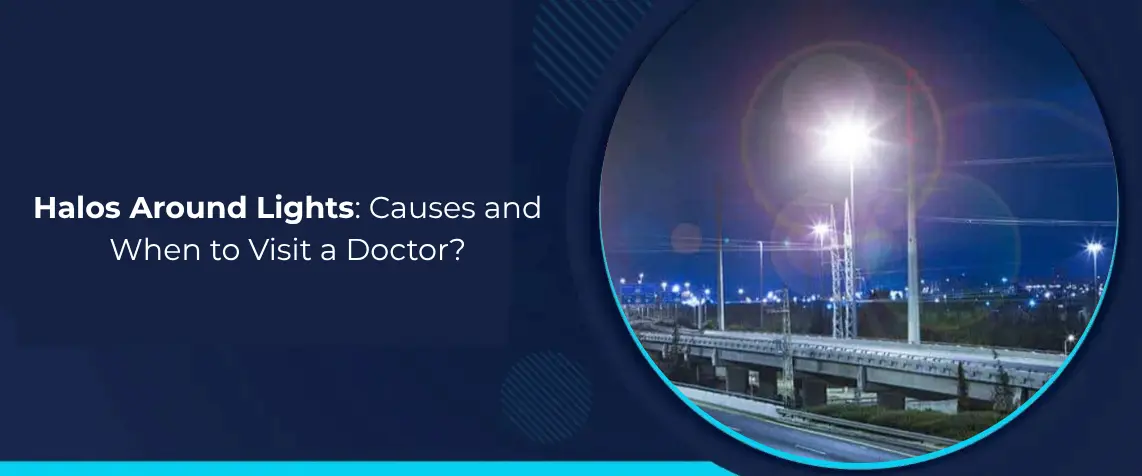
Rings around lights and headlights while driving might be the first thing you notice. Then increased discomfort and difficulty driving due to visual disturbances. But why do these rings or halos suddenly start appearing? Is it normal or something to worry about?
Your doubts are absolutely valid. In this blog, we will discuss the common causes of halos around lights, whether you should be alarmed, and when to see a doctor immediately.
| If you suddenly notice increased halos, followed by blurred vision or eye pain, an eye checkup from an eye specialist may help you get answers. |
Read more on:
ToggleOverview
Let us start by clarifying that seeing halos around light is not always a cause for concern. But if you’ve never experienced them before and they suddenly appear, affect only one eye, or are accompanied by pain, that’s when they should be treated as medical concerns.
If you’re seeing coloured or rainbow halos, along with eye pain, headache, nausea, or redness, you may need same-day medical care. This may be a sign of a sudden increase in eye pressure.
Is It Normal to See Halos Around Lights?
Typically, yes. Why is that? Let’s find out!
Halos or glare around bright lights at night, to some extent, are normal, even if you have healthy eyes. In dim lighting, your pupils tend to widen more in order to let light in. A wider-than-usual pupil uses more of the outer edge of the cornea or natural eye lens. This is what causes the appearance of rings around light.
If you’ve always experienced faint rings around bright lights, it may just be how your eyes have always functioned.
What is NOT Normal?
Halos need your attention when they are:
- Worse than before or new
- Debilitating (progressively worsening)
- Affecting only one eye
- Accompanied by unclear vision
- Accompanied by headache, redness, nausea, or pain
- Causing difficulty in night driving
Let’s see how you can tell them apart.
When is Emergency Care Required?
Most causes of halos can usually be dealt with at routine eye checkups. But there is one that must be addressed immediately:
🚨 Emergency care is non-negotiable if you are seeing coloured or rainbow halos, accompanied by the following:
- Redness
- Extreme pain in one eye
- Vomiting or nausea
- Headache
- Rapidly diminishing or blurring vision
- Larger than usual pupil
These symptoms may point to a sudden blockage in the drainage system of the eye, leading to increased eye pressure (intraocular pressure or IOP). When this happens, the cornea may swell up due to excess fluid. This swelling is what makes light scatter into coloured or rainbow rings. This is a well-known ophthalmic emergency as it can lead to vision loss or impairment if not treated in a timely manner. This is often also associated with angle-closure glaucoma.
It is crucial to notice the presence of the visual symptoms as well. This is because, for some people, the vomiting, nausea, and headaches can be so severe that people often get assessed and misdiagnosed with an upset stomach or a neurological problem, while the eyes remain unaddressed. This is why it’s important you identify your symptoms and communicate them to your healthcare provider immediately.
Common Causes of Halos Around Light
Cataract
If you’re over 50, cataracts may be the most common cause of seeing halos around light.
As the natural lens of the eye becomes hard and cloudy, light tends to scatter as it passes through it. These may be more noticeable at night, which is why night driving becomes difficult.
Cataract halos develop over months or even years for some. They generally affect both eyes at the same time, but their rate of development may be different. They are typically not accompanied by pain and dissipate once the affected individual undergoes cataract surgery.
Cataract surgery is advised when the symptoms progress to an advanced stage and start affecting everyday life.
Corneal scarring or swelling
The cornea is the clear, outer part of the eye. In some conditions, if the cornea swells up or loses its transparency, it will cause the light entering the eye to scatter.
This may be caused by overuse of contact lenses, an injury, or previous eye surgery. Regardless of the cause, corneal swelling can result in halos. These may feel worse right after you wake up and tend to improve as the day progresses.
Dry Eyes
This is a very common yet overlooked cause for seeing halos around lights.
The tear film is the first surface that any light entering the eye meets. When that film is unstable or thin, the surface may become uneven, causing light to scatter. Halos fluctuate more when you’ve been in air conditioning, after prolonged screen use, or in windy weather.
Additionally, if your vision momentarily clears upon blinking, it could point to dry eye. This is among one of the more treatable causes of halos.
After Vision Correction
Halos, starbursts, or glare are some common after-effects of vision correction surgeries like LASIK, ICL, or SMILE Pro. For most individuals, these subside within a few weeks as the cornea heals and the brain adapts better to the new vision. This is normal, but remember, recovery varies from person to person.
If they don’t subside even after months of your vision correction treatment, you can mention it to your LASIK surgeon at a follow-up visit. If you notice the appearance of new halos months after the post-LASIK ones went away, their cause may be different, and an assessment may be necessary.
Raised Eye Pressure
Increased pressure in the eyes is a common reason for corneal swelling and the appearance of halos. If you have been using steroid eye drops for a long time and start noticing halos and diminishing vision, seek medical care immediately.
Other Reasons
Other reasons include side effects of cataract surgery, large pupils, uncorrected eye power, optical imperfections, tear-film irregularities, and changes in the cornea or natural lens.
When to Visit a Doctor
Here’s a concise look at when to schedule a visit to your eye doctor immediately, or discuss at the next follow-up appointment or at regular checkups.
| TYPE OF HALOS | WHEN TO SEE A DOCTOR |
| Coloured or rainbow halos, along with redness, pain, nausea, headache & vomiting | Seek medical care immediately |
| Halos with one eye’s pupil enlarged | Seek medical care immediately |
| Halos with sudden vision loss | Seek medical care immediately |
| New halos in only one eye | Seek medical care immediately |
| Halos that come and go (in bright light) | At the next follow-up appointment |
| New halos months after a cataract or refractive surgery | At the next follow-up appointment |
| New halos after a new eye drop or medication | At the next follow-up appointment |
| Halos within the expected recovery period of a refractive or cataract surgery | At routine eye checkups |
| Halos that increase gradually, without pain, in both eyes | At routine eye checkups |
| Halos after screen use that improve with blinking | At routine eye checkups |