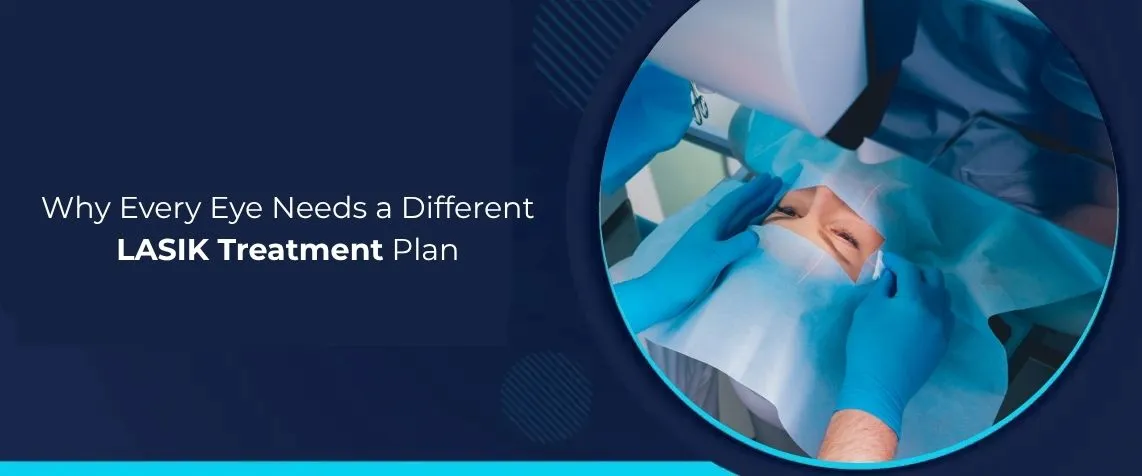
LASIK has become a popular choice for many people who want to reduce their dependence on glasses or contact lenses. But while the procedure is widely known, one important fact that few people may be aware of is: There is no single LASIK treatment that is suitable for every eye.
Two people may have the same spectacle power, yet their corneal shapes may differ significantly. The same holds true for their eye-surface health and visual requirements. That is why a personalised eye evaluation or LASIK screening is an essential part of laser vision correction.
Read more on:
ToggleSpectacle Power: The First Step in Your Journey
Most people decide to get LASIK because they have eye power or a prescription. LASIK surgery can generally be performed for refractive errors up to -12 D, given the individual meets all eligibility criteria. For a prescription above this, you may need to explore other treatment options.
| -12 D has been taken as a frame of reference, as it is generally the highest eye power that LASIK surgeons assess to be corrected by LASIK. It is not a universal limit. The treatable range for every individual differs on the basis of their unique eye anatomy. |
LASIK works by reshaping the cornea so that light focuses more accurately on the retina. LASIK procedures can correct common refractive errors such as:
- Myopia (nearsightedness)
- Hyperopia (farsightedness)
- Astigmatism (cylindrical power)
However, this is not the complete story. Having an eye power alone does not mean you can undergo LASIK vision correction treatment.
Before recommending a particular type of LASIK, an ophthalmologist needs to assess various factors, including:
- The overall health of your eyes
- The stability of your prescription
- Corneal shape and thickness
- Tear film quality and other factors
These measurements help determine whether you are a suitable candidate and, if yes, what treatment approach (specific LASIK/laser type) may be appropriate.
Cornea: Shape and Thickness May Vary
The cornea refers to the clear front surface of the eye. It plays a key role in the focusing ability of the eye. Its shape and thickness can vary considerably from one person to another.
Which tests help identify corneal issues that may affect the safety or predictability of laser vision correction? Your ophthalmologist may conduct detailed tests such as corneal topography and others to detect any irregularities in the cornea.
Corneal thickness tests are also conducted to assess the thickness of the cornea. This is because LASIK involves flap creation and reshaping of the corneal tissue. Certain corneal conditions, such as keratoconus or significant thinning, may make LASIK unsuitable since the procedure requires the cornea to be adequately thick.
You should not choose LASIK based only on your glasses number. Corneal tests are essential.
Eye Health: It Can Influence the LASIK Plan
A healthy ocular (eye) surface is another important part of LASIK planning.
People with dry eyes or other eye problems may need treatment before getting refractive surgery. This is because an unhealthy or unstable tear film (as happens in dry eye cases) can make dry-eye symptoms worse after LASIK.
Depending on the severity of their dry eye condition, some patients may get dry eye treatment first. Once their dry eye condition is under control, they can have another eye exam to check if they are suitable for LASIK.
Alternatively, such patients can talk to their eye doctor about other vision correction procedures such as SMILE Pro and ICL.
Personal Goals: Your Lifestyle and Visual Needs
LASIK planning also depends on your everyday visual needs.
Some individuals may need to spend long hours working on a computer, while others may be fond of outdoor activities like sports, travelling, hiking, etc. Some others may need to drive frequently at night, and yet others may be in professions where glasses can be inconvenient.
Discuss your expectations with your doctor. LASIK is designed to reduce dependence on corrective eyewear. But some people may still require glasses for specific activities or later in life.
Age: An Important Consideration
The visual requirements for those aged 18-40 are typically different from those of individuals aged above 40.
This is because younger people have vision issues due to changes in the eye shape. They may have myopia (nearsightedness: eyeball grows too long), hyperopia (farsightedness: eyeball is shorter or flatter than normal), or astigmatism (distorted vision at all distances: irregular shape of the eye).
On the other hand, those aged above 40 usually face problems with close vision (presbyopia) due to reduced flexibility of the eye lens. At the same time, they may have other vision issues, too (myopia, hyperopia, astigmatism).
What it means is: a person considering LASIK in their 20s would require different treatment from someone planning vision correction in their 40s or 50s.
Depending on your age and kind of vision issue you have, your ophthalmologist can discuss which LASIK/laser treatment you can consider.
LASIK: Are You Eligible?
While most people with refractive errors are eligible for LASIK, there may be some for whom LASIK may not be an ideal choice.
When we say every eye needs a different treatment plan, it also means checking your LASIK eligibility. Which factors make you ineligible for LASIK?
- An unstable prescription (specs power must have been stable for a year)
- Certain corneal abnormalities (e.g., keratoconus)
- Inadequate corneal thickness
- Severe dry eye
- Some other eye or systemic conditions (advanced glaucoma, uncontrolled diabetes, etc.)
If found unfit for LASIK during LASIK screening tests, you can explore other vision correction options like SMILE Pro, ICL, and PRK.
Choosing LASIK only when your doctor declares you fit for it is an important aspect of eye safety and long-term visual health.
Personalised LASIK: It Starts With a Thorough Evaluation
LASIK has evolved over the years. From a one-size-fits-all approach to personalisation, it has come a long way.
The goal of customised LASIK/laser vision correction is not simply to perform the same procedure on every patient. It is to understand what makes each eye different and use that information when deciding whether LASIK treatment would be appropriate and how to plan it.
From your prescription (specs number) and corneal measurements to your eye health, overall health, age, lifestyle, and expectations, every detail affects the decision.
LASIK Eligibility Tests may include:
- Refractive eye examination to verify prescription
- Slit Lamp Examination to assess overall eye health
- Pachymetry to measure corneal thickness
- IOP Test to assess eye pressure
- Wavefront Analysis to identify higher-order aberrations
- Tear Film Evaluation for eye dryness
- Corneal Topography to check corneal shape
The reason is that your eyes are as unique as your fingerprints. In fact, even your own two eyes may be different. It’s common to see people with -4D in one eye and -4.5D in the other.
If you are looking forward to getting LASIK, consult an experienced eye doctor. They will conduct a comprehensive eye evaluation to check which LASIK will be appropriate for your eyes and advise you accordingly.
Sohana Hospital offers a range of LASIK/laser treatment options:
- Wavelight Plus InnovEyes
- SMILE Pro
- Contoura Vision
- LASIK
- PRK
- PRESBYOND
- ICL
- RLE
Your eyes are unique. So should be your LASIK treatment.