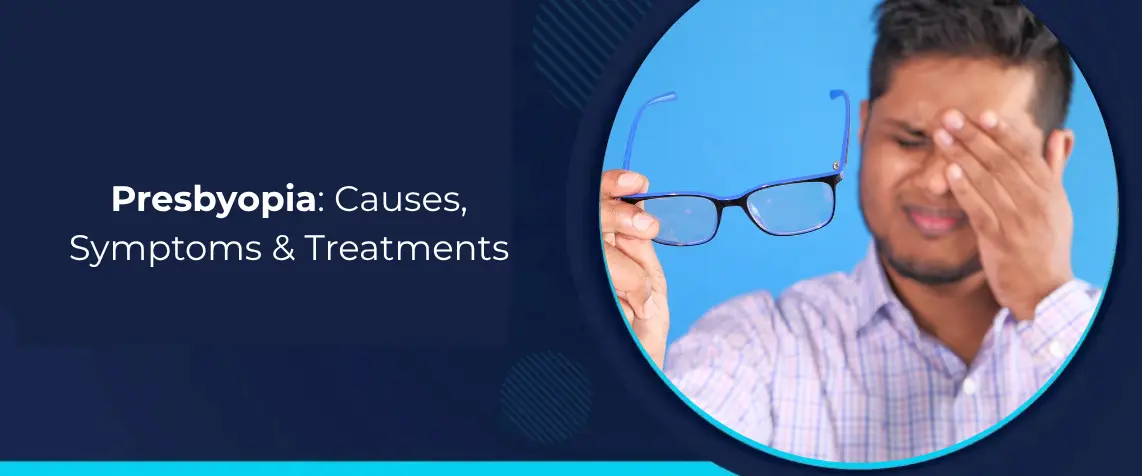
हिंदी में पढ़ें: प्रेसबायोपिया: कारण, लक्षण और उपचार
Presbyopia is a refractive error that develops after the age of 40, with a natural decline in vision as one ages. This happens because, as we age, the natural lens of our eye becomes less flexible.
Who is affected by this refractive error? Nearly everyone over the age of 40 develops presbyopia as it is a natural part of ageing. For decades, people struggled with reading glasses and contact lenses until they’d eventually need cataract surgery (which also corrects vision with the customisable IOLs). But with the advancements in the vision correction sector, today there are a multitude of specs removal options for 40+ individuals.
In this blog, we are going to discuss presbyopia, its causes, symptoms, and all possible correction options.
What is Presbyopia?
Presbyopia refers to the natural decline in eyesight as your eye loses its ability to shift focus between near and far objects. This results in difficulty in close-up tasks. Presbyopia develops as a result of the eye’s natural lens losing its flexibility.
Presbyopia typically begins to develop around 40 years of age and can continue to progress until the mid-60s. This means holding your phone or the newspaper at an arm’s length to see clearly.
| 👉 Note: Developing presbyopia is a natural part of getting older, which is why it is not considered a disease. |
Presbyopia Symptoms
Look out for these signs and symptoms:
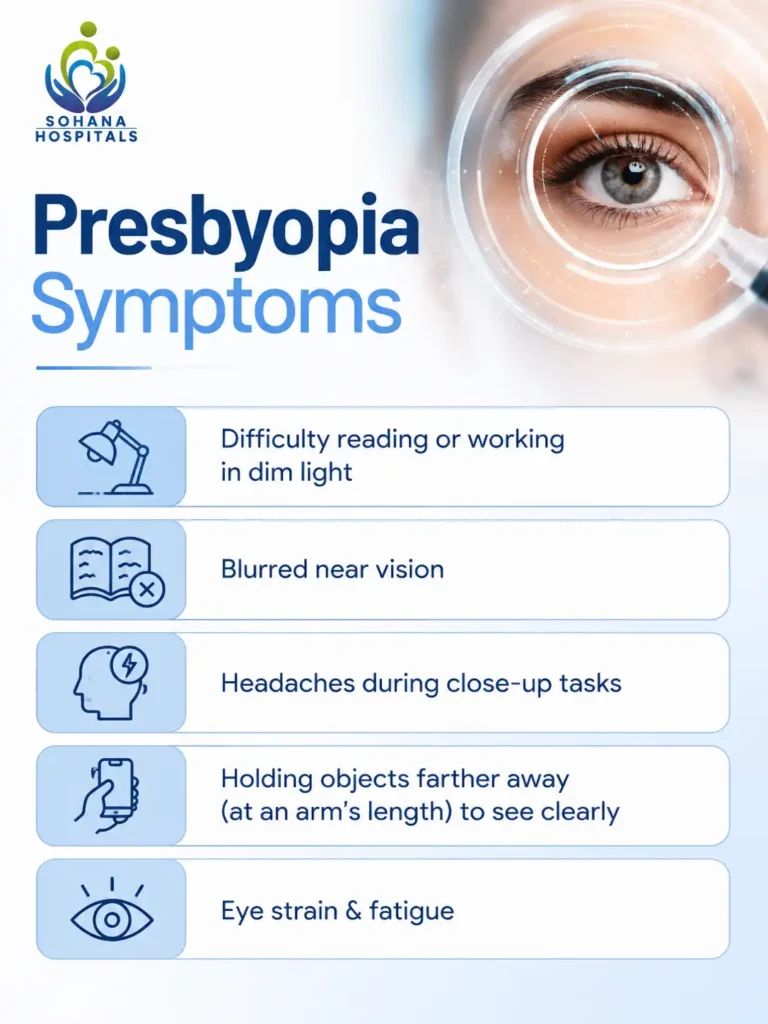
- Difficulty reading or working in dim light
- Blurred near vision
- Headaches during close-up tasks
- Holding objects farther away (at an arm’s length) to see clearly
- Eye strain & fatigue
Presbyopia Causes
During the early decades of your life, the natural lens of your eye is flexible and soft. It can change in shape as you shift your focus from distant to close-by objects. This allows light to enter your eye, focus on the retina, facilitating clear vision.
However, as you age, this lens loses its flexibility and no longer focuses light exactly as it should. People begin noticing the first signs in their 40s.
| 💡 DID YOU KNOW? According to a study conducted in 2015, out of the total global population, 1.8 billion individuals had presbyopia. The numbers in 2026 could be much higher! |
The lens of your eye continues to grow and form new layers of cells. It’s this process that thickens the eye lens and makes it lose flexibility.
Presbyopia Treatment Options at Sohana Hospital
Like any other refractive error, presbyopia can also be corrected through various means. If we look at temporary options – eyeglasses and contact lenses can help correct the condition when in use.
But for people who wish to gain permanent visual clarity, Sohana Hospital boasts a variety of surgical options.
PRESBYOND Laser Blended Vision
PRESBYOND Laser Blended Vision is the latest and most advanced laser vision correction for presbyopia. The technology corrects one eye for clear distant vision, and the other for clear near vision, overlapping the field of vision in both. This facilitates clear vision during near, intermediate, and distant tasks.
Refractive Lens Exchange (RLE)
RLE corrects presbyopia by replacing the natural eye lens with a biocompatible artificial lens (an IOL). The best part about choosing RLE? Not only does this correct your age-related decline in vision, but it also eliminates the possibility of developing cataracts in the future.
| 💡 Cataracts are protein deposits that accumulate in the natural eye lens, resulting in hardening of the lens, along with vision impairment and loss. RLE replaces the natural lens with an artificial one; therefore, the possibility of lens proteins getting accumulated is eliminated. |
Implantable Collamer Lens (ICL)
ICL surgery corrects presbyopia by implanting an IOL permanently inside the eye, in front of the natural lens. The IOL is completely customisable to each patient’s unique eye power and requirements. ICL surgery’s unique advantage? It is reversible, meaning if your refractive error ever progresses in the future and you need a different power IOL to see clearly, ICL leaves that possibility open!
Besides these, the hospital also has an array of cataract-refractive surgeries that tackle two conditions – cataract and existing refractive errors – at the same time. A team of highly skilled surgeons and support staff ensures proper diagnosis and a smooth surgical experience for every patient who walks through our doors with the dream of specs-free clear vision (even after 40!).
Struggling with reading glasses & wish to get rid of them? Book your vision correction consultation at Sohana Hospital today!