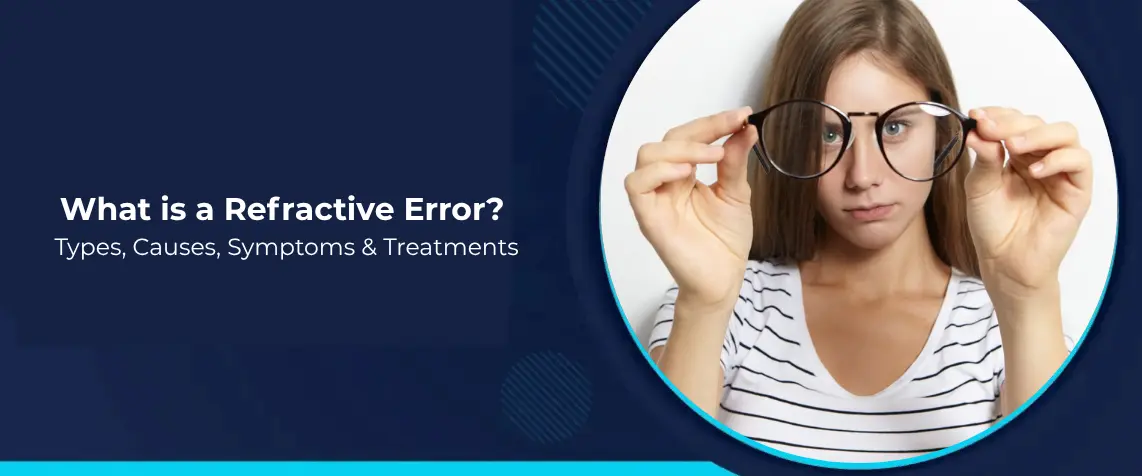
Refractive errors are eye conditions that result in unclear/blurry vision. These are typically not a cause for concern and do not require much more than corrective visual aids such as a pair of prescription spectacles or contact lenses.
However, a more permanent solution for freedom from refractive errors is LASIK/laser vision correction procedures.
In this blog, we will discuss in detail what refractive errors are, their types, causes, symptoms, and potential treatment/management options.
What are Refractive Errors?
Different parts in your eye(s) work together like members of a relay team. Light entering the eye is transmitted along a pathway to the brain. Light rays enter your eye through the cornea. The cornea is responsible for focusing the light onto the retina through the lens. The retina then converts this light into electrical signals, which are sent to the brain via the optic nerve. Your brain finally perceives those signals as the images you see in front of you.
| 💡 Cornea: The clear, outermost part of the eye. |
| 💡 Retina: Light-sensitive layer of tissue at the back of the eyeball. |
| 💡 Optic nerve: This is the 2nd cranial nerve that takes electrical signals from the retina directly to the brain. |
Depending on the type of refractive error, your eye will be abnormally shaped. The abnormal shape of your cornea prevents light from focusing on the retina, resulting in unclear vision.
There are different types of refractive errors. Depending on which kind you have, you may find it difficult to see clearly:
a.) at distance (far)
b.) at close-up objects
c.) at all distances
| 🚨 If you notice visual discomfort and unclear vision at any distance, schedule a consultation with a trusted eye care professional. |
Types of Refractive Errors
There are 4 common types of refractive errors:
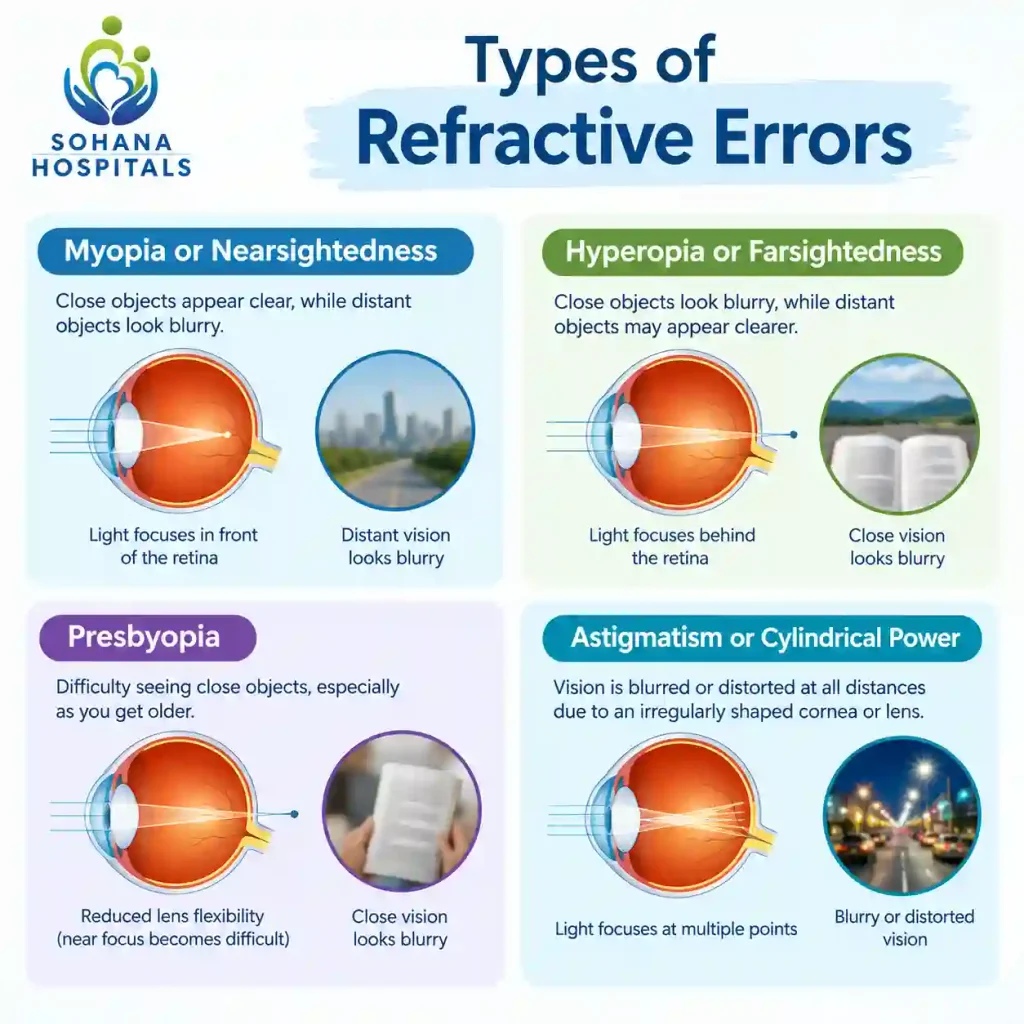
Myopia or Nearsightedness
Myopia, more commonly known as nearsightedness, refers to a type of refractive error where the eye is too long from front to back. This results in light falling in front of the retina instead of on it.
Another cause of the condition is your lens or cornea being too curved in shape. Consequently, people with myopia experience difficulty seeing distant objects clearly, whereas their near vision remains perfectly clear.
| For example: You’re walking on the road and look up to read a billboard, but the font appears too blurry. When you look back down at your feet and the footpath, they appear clear. This indicates you’re having difficulty seeing things clearly from a distance, while your near vision is clear. |
Nearsightedness typically starts developing in young children, around the age of 8-10 years. The error can continue to progress, worsening distance vision, if corrective strategies are not employed in a timely manner.
Hyperopia or Farsightedness
Hyperopia, more commonly known as farsightedness, is when you find it difficult to see close-up objects clearly. Essentially, it’s the exact opposite of myopia.
| For example: You are able to see what’s written on the board from afar but cannot read the contents of the book in your hand clearly. |
Hyperopia develops when your eye is too short from front to back. Another cause for the condition is your lens or cornea being too flat. Farsightedness is generally congenital, but it can develop later in life, too.
Presbyopia
Presbyopia is an age-related vision decline condition. It’s a specific type of farsightedness that only develops with age. Similar to hyperopia, presbyopia makes it difficult to focus on close-up tasks as people age.
The condition develops when the natural eye lens becomes less flexible. It typically develops after the age of 40 and is the most common reason for the increased need for reading glasses.
Astigmatism or Cylindrical Power
Astigmatism, or a cylindrical eye power, leads to blurry vision at all distances. This happens due to an irregular shape of the cornea. This results in the light bending and distorting more than it should.
There is no fixed onset age for astigmatism. It can develop at any time in your life.
Refractive Error Causes
Refractive errors develop due to changes in the shape of your lens, cornea, or eyeball. The type of anomaly in the shape of your eye determines the type of refractive error.
Additionally, age is another cause for the development of refractive errors like presbyopia.
Refractive Error Symptoms
Some common signs and symptoms of a refractive error include:
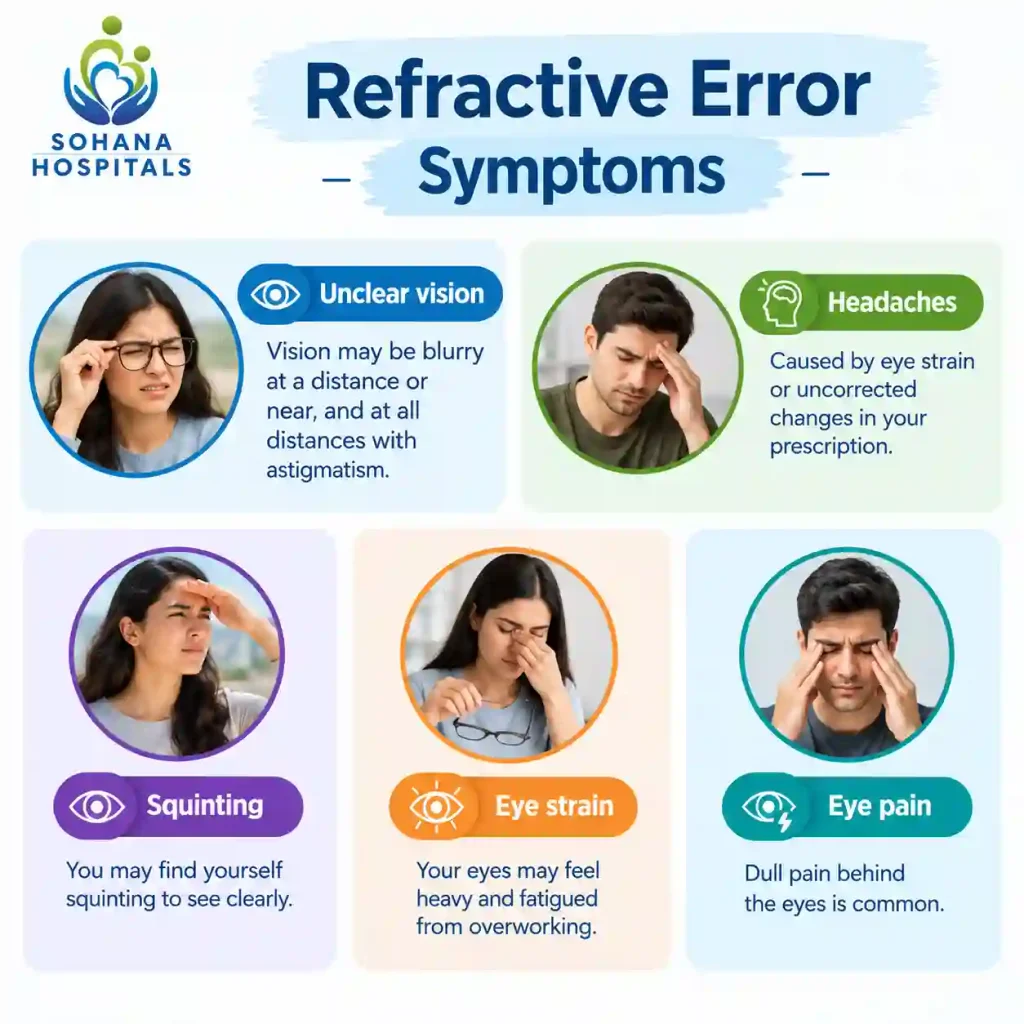
Unclear vision
Depending on the type of error, you may experience unclear distance or near vision. In the case of astigmatism, you may have blurry vision at all distances.
Headaches
If your refractive error remains unaddressed and uncorrected, or if your number has changed recently, you may experience headaches as a result of strain.
Squinting
Again, in the case of uncorrected eye power, you may find yourself squinting to see clearly.
Eye strain
When your eyes are working overtime to focus on what’s in front of them, the eye muscles get strained. As a result, your eyes may feel heavy and fatigued.
Eye pain
Dull pain behind the eyes is another common sign of uncorrected eye power.
Refractive Error Treatment
Refractive errors cannot be “cured”, but there are corrective options that offer long-term solutions:
Corrective eyeglasses
The first line of treatment when diagnosed with a refractive error is prescription glasses. These visual aids are personalised according to your eye power and help you see clearly when in use.
Contact lenses
Soft contact lenses or ortho-K contact lenses (typically prescribed for young children) are employed to provide clear vision. Soft contact lenses provide clear vision according to your eye power when they are in use. Ortho-K lenses, on the other hand, are only worn overnight – they temporarily change the shape of the cornea to provide clear vision during the day.
Atropine drops
While not a ‘treatment’, these drops are prescribed for children recently diagnosed with myopia to slow down its progression.
Vision correction surgery
Vision correction surgeries are either LASIK-based, laser-based, or lens-based.
LASIK-based surgeries (For eg: Wavelight Plus InnovEyes, Contoura Vision) involve creating a flap on the cornea, then reshaping the underlying tissue with a laser to provide clear vision.
Laser-based surgeries either rely on surface ablation (PRK) via laser without an incision or lenticule extraction (SMILE Pro) via a tiny laser-made incision for reshaping the cornea. Either way, the motive is to reshape the cornea to facilitate clear vision.
Lens-based surgeries (ICL), on the other hand, involve implanting a biocompatible artificial lens inside your eye (not visible from the outside). This lens is customised to your eye power & other visual needs.
If you suspect that your child is showing signs of weakening eyesight, don’t delay their checkup. Schedule a visit with the experienced eye specialists at Sohana Hospital for a complete eye evaluation and prompt myopia management.
The institution boasts Chandigarh, Mohali, and Panchkula’s 1st ever dedicated Myopia Management Clinic. With over 20 eye care professionals, we ensure your child gets the right care against myopia.
That being said, refractive errors can develop at later stages in life, too. If you or a loved one has recently experienced vision changes or blurry vision, don’t brush these symptoms off; seek medical intervention at the earliest for comfortable and long-lasting clear vision.