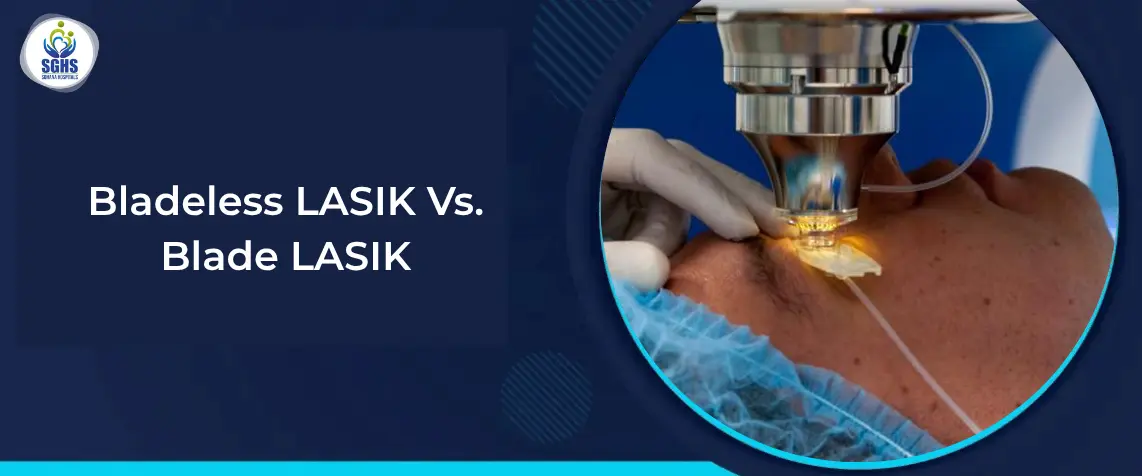
Bladeless LASIK or Blade LASIK – which option is the best for you?
Before we can determine which option is the best for your eyes, it is essential to understand the difference between the two. LASIK, or Laser In Situ Keratomileusis, involves correcting refractive errors like myopia (nearsightedness), hyperopia (farsightedness), and astigmatism (cylindrical power) by reshaping the cornea (the clear, outermost layer of the eye). To reshape the cornea, a flap is created that allows the laser application and subsequent vision correction.
In simple words, ‘bladeless’ and ‘blade’ LASIK differ in the way the corneal flap is created. Blade LASIK makes use of a microkeratome – a mechanical blade to make the incision for the corneal flap. Whereas bladeless LASIK uses a femtosecond laser to create the corneal flap.
Read more on:
ToggleBlade LASIK
Also known as conventional or traditional LASIK – this technology has been around for a long time. In this procedure, the surgeon uses a microkeratome to make a hinged flap on the cornea. The flap is gently lifted and placed to the side to allow for excimer laser application to the underlying corneal tissue.
Once reshaped, the flap is gently placed back in its original position. The flap naturally re-adheres in a few days, and patients notice vision stabilisation and enhanced clarity without discomfort in 1-3 weeks.
Bladeless LASIK
Also known as femto-LASIK, this technology is an advancement of traditional LASIK. This procedure involves creating the corneal flap through a precise femtosecond laser. Every other step in the procedure is similar to blade LASIK, yet this surgery is considered way more advanced than the former – why is that?
This is because when the surgeons use a femtosecond laser to create the corneal flap, the scope for human error is eliminated. The incision is more precise; hence, it heals relatively faster than a manual incision.
| 👉 Note: It is important to note that, regardless of the technology used, the recovery speed after LASIK surgery varies from person to person. Each individual’s body and rehabilitation process are different. A femtosecond laser incision alone cannot guarantee a faster healing process. |
Difference Between Blade & Bladeless LASIK
| BASIS OF DIFFERENCE | BLADE LASIK | BLADELESS LASIK |
| Flap creation | Microkeratome (mechanical blade) | Femtosecond laser |
| Precision | Good, but thickness may vary | Highly precise; human error is eliminated |
| Visual results | Very good if performed by experienced surgeons | Slightly more enhanced due to higher precision |
| Duration | Shorter suction time | Flap creation may take slightly longer (by a few seconds) |
| Cost | Generally lower | Generally higher than traditional LASIK due to advanced technology |
| Pain | No pain during procedure | No pain during procedure |
| Recovery | Generally slower | Generally faster as compared to conventional LASIK |
Whether blade LASIK is the best option for you or bladeless depends entirely on your pre-LASIK screening tests.
| 👉 Pre-LASIK screening tests are a series of diagnostic tests and scans that assess your corneal thickness, tear film quality, retinal health, and general eye health. This determines your eligibility for LASIK in general, as well as helps decide which particular type of LASIK fits you best. |
It’s easy to pit different technologies against each other – but the truth is that no one technology can deliver guaranteed results UNLESS your eyes are suited for it. Both blade and bladeless LASIK stand as equally worthy contenders in the specs removal sector – trusted by millions every year!
Sohana Hospital boasts an array of LASIK surgery options for your unique eyes. The institution also has the best LASIK surgeons in Chandigarh who ensure you get the right guidance to make an informed decision.
Stop debating blade vs bladeless in your head
Consult an eye specialist & get the right answer for your eyes today!