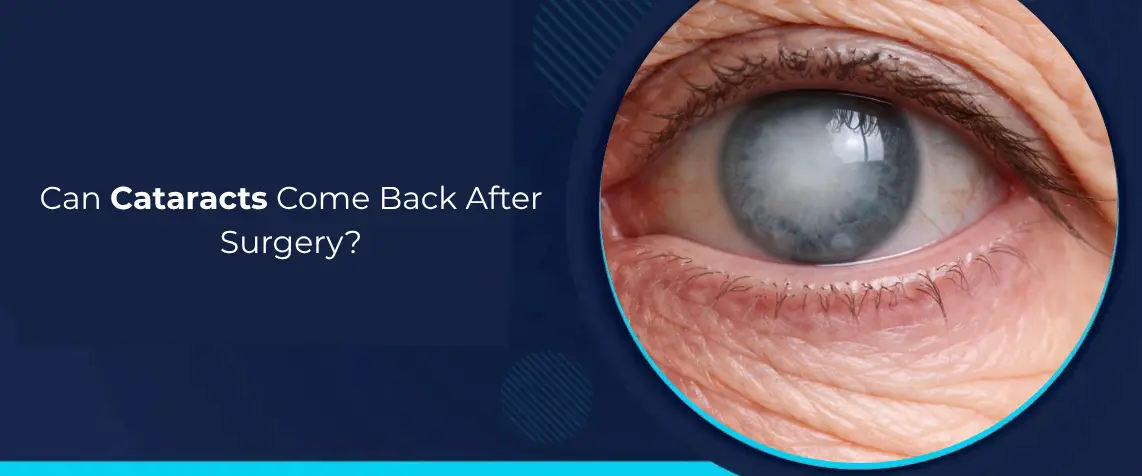
This is a question a lot of patients may have in their minds while considering cataract surgery. The answer is: no. Cataracts do not return once you get your eye(s) operated on.
Having said that, it is important to understand that sometimes, other conditions may arise that result in blurry vision.
In this blog, we are going to elaborate on the working of cataract surgery, what to expect in the years after cataract treatment, and why some people may feel cataract has come again.
Read more on:
ToggleWhat are Cataracts?
Cataracts refer to the clouding of the eye’s natural lens due to protein accumulation. Factors leading to cataract formation include the natural ageing process, smoking, prolonged UV exposure, and underlying health conditions such as diabetes.
Cataract symptoms include:
- Blurred vision
- Light sensitivity
- Night vision issues
- Halos around lights
- Faded or yellowed colours
- Double vision
- Frequent changes in specs number
What Happens During Cataract Surgery?
Cataract surgery is an effective way to restore clear vision once your natural eye lens has hardened.
It involves removal of the clouded natural eye lens, which is then replaced with a clear artificial lens. This artificial lens is known as an intraocular lens (IOL). Once implanted in the eye, it stays there permanently. Since it is artificial, it does not become cloudy.
Since the blurry natural eye lens is removed, you can rest assured that cataracts cannot return.
How Long Does Cataract Surgery Last?
Many cataract patients wonder if surgery is going to be a permanent solution. Cataract surgery is designed to provide long-lasting clear vision and boasts an impressive success rate of nearly 95%.
The IOL that replaces the eye’s natural lens is synthetic. IOLs are designed to stay clear; clouding is very rare. Hence, it is not possible for cataracts to come back after surgery.
What Makes Some People Think Cataracts Have Come Back?
Some patients may experience symptoms similar to those of cataracts long after they had a successful cataract surgery. It could be weeks, months, or years before you feel your vision is less than optimal.
Here are the common reasons for such symptoms:
Posterior Capsular Opacification (PCO)
The underlying cause is generally a condition known as Posterior Capsular Opacification (PCO), sometimes also referred to as secondary cataract. Generally, PCO occurs between 1 and 5 years after surgery. Even though cataracts can’t return, you may require treatment if PCO develops.
The good news is that PCO is not a true cataract, but an easily treatable secondary condition.
Residual Refractive Error
In some patients, the IOL may not match your eye power. Alternatively, subtle post-op changes in the eye structure may modify the way light is focused on the retina. Astigmatism is a common cause. This minor misalignment may cause a little blurriness. This can be easily corrected with a slight adjustment in your specs prescription.
Dry Eye Syndrome
Some patients may have dry eyes post-surgery. This condition can be effectively managed with simple treatments, such as lubricating eye drops or alterations in post-op care.
Read more: Dry Eye Syndrome: Symptoms, Causes & Treatment Options
What is Posterior Capsular Opacification (PCO)?
Cataract surgery places the new artificial lens (IOL) within the capsule in which your natural lens existed earlier. With the passage of time, clouding of this capsule can occur, making you feel you’re looking through a fogged-up window. This is PCO (Posterior Capsular Opacification), sometimes referred to as a “secondary cataract.”
While this isn’t a cataract, symptoms can be similar:
- Hazy or blurry vision
- Problems with night vision
- Glare from lights
- Both near and far vision affected
PCO affects roughly 20-30% of adults within 5 years with older IOLs, but occurrence is lower with modern designs. PCO can be treated easily and completely through a treatment called YAG laser capsulotomy. It is done in the OPD itself, is totally painless, and requires only a few minutes.
PCO treatment with YAG Laser Capsulotomy: Highlights
- Uses a laser to correct your vision
- Totally painless
- Takes only a few minutes
- No hospital stay
- Improved vision in 24-48 hours
- No need for another cataract surgery
- The problem does not return
Got cataract surgery but experiencing unclear vision? A quick eye examination can identify if PCO or any other condition is the reason.
Modern Cataract Surgery Technologies
With advancements in cataract surgery, the risk of post-op issues such as posterior capsular opacification has significantly reduced. Widely used cataract technologies include 4D Phacoemulsification, MICS (Micro-Incision Cataract Surgery), and FLACS (Femtosecond Laser-Assisted Cataract Surgery).
These procedures, paired with modern IOL designs, are minimally invasive and effective in restoring clear vision. The goal is to ensure that patients recover smoothly and have better long-term visual outcomes.
Conclusion
Cataracts do not return once you get cataract surgery. However, sometimes a condition called PCO (Posterior Capsular Opacification), with symptoms resembling cataract, may arise in some patients.
But it is not a cause for concern since it can be quickly and easily treated with an outpatient laser procedure, restoring clarity of vision again.
Sohana Hospital provides cataract surgery options like:
- 4D Phacoemulsification
- MICS (Micro-Incision Cataract Surgery)
- FLACS (Femtosecond Laser-Assisted Cataract Surgery)
- Premium IOLs
Frequently Asked Questions
Can the Artificial Lens (IOL) Become Cloudy?
No. The artificial lens that cataract surgery uses stays clear for life since it is made from materials like silicone or acrylic.
Vision turning blurry after cataract surgery is often due to PCO, residual refractive error, dry eyes, etc.
Does the need for cataract surgery arise again?
Most patients do not require cataract surgery again. An artificial lens is put in place of the natural eye lens so that cataract does not come back.
Any blurry vision weeks, months, or years after surgery is often due to PCO, which is a treatable condition.
How successful is cataract surgery?
Research indicates that cataract surgery has an impressive success rate of nearly 95%. (via NIH)
What if my cataract surgery was done many years ago?
Even if you underwent cataract surgery 20 years ago, the artificial lens continues to work. However, PCO may develop gradually in some patients. Regular eye exams are still needed for other age-related conditions.