*हिंदी में पढ़ें: रात में रोशनी के चारों ओर हेलो/प्रभामंडल (Halos) क्यों दिखाई देते हैं?
“Why do I see halos around light at night?” – If you often find yourself asking this question, we’ve got answers for you!
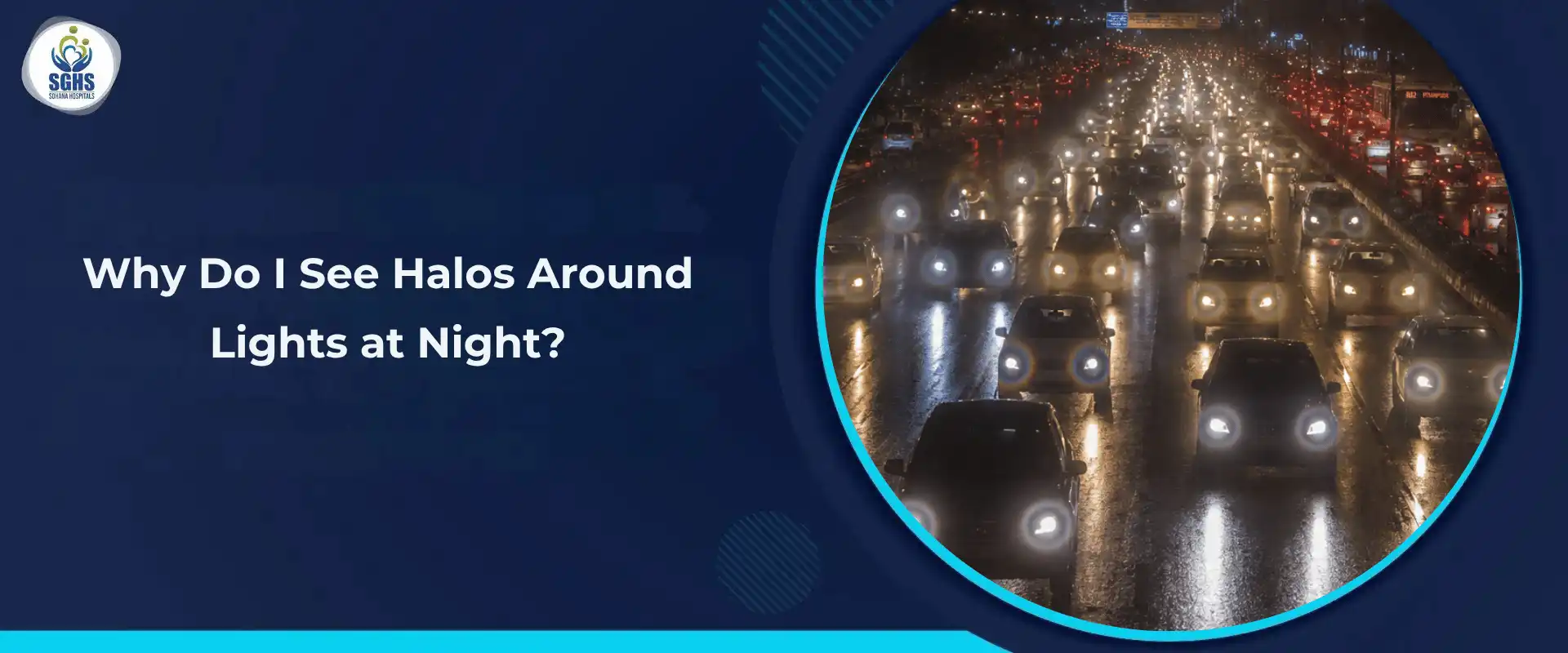
You’re driving down a busy road at night. The traffic taillights seem distorted and have halos around them, making night driving feel like a hassle? Don’t panic, halos in vision are pretty common, especially as you age.
We understand seeing halos can feel alarming, but it’s important to remain calm and avoid night driving (if possible) until you have consulted a trusted specialist and received proper answers.
Now, to answer the question, why do some people see halos in the first place – reasons for halos in night vision range from refractive errors to other eye conditions. In this blog, we are going to discuss all the reasons that could potentially lead to halos.
What Causes Halos in Your Vision?
To understand halos, let’s start with an overview of how your eyes function.
The outermost, clear layer of the eye, known as the cornea, slopes slightly and is round in the middle. For some individuals, this slope can be steep, like a cone or other shapes. Now the shape of your cornea greatly impacts how light enters your eye, leading to disturbances like distorted vision, halos, etc.
It is also worth noting that these visual disturbances don’t just affect your vision at night. In fact, they become more noticeable at night or in low-lit spaces.
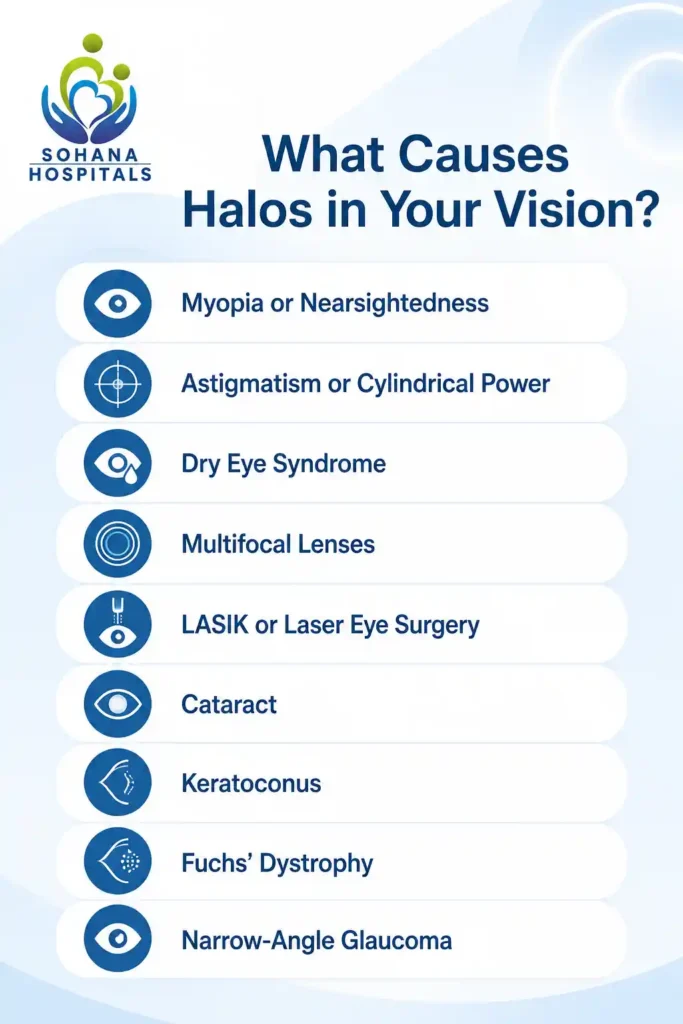
Myopia or Nearsightedness
Individuals with nearsightedness or myopia have difficulty seeing distant objects. Myopia can lead to difficulties seeing clearly at night. When your eyes struggle to see clearly, your pupils naturally dilate to try to see in the dark. As your pupils open wider, more peripheral light enters your eyes. When this additional light hits the further periphery of the lens, you may experience substantial changes (disturbances) like halos in vision.
Astigmatism or Cylindrical Power
Astigmatism is caused by an irregular curvature of the cornea. The irregularly shaped cornea affects how light enters & transmits through the eye, leading to blurred vision and halos.
Other visual disturbances like glare, streaks, starbursts, etc., around lights are also very common among people with astigmatism.
Dry Eye Syndrome
While dry eye is mostly associated with excessive watering, gritty sensation, and irritation in the eyes, it can also affect vision. If the surface of the eye is not adequately lubricated, it can affect how light is transmitted into the eye, thereby resulting in halos.
*Note: Not every individual who has dry eyes sees halos in their vision.
Multifocal Lenses
Some individuals need the help of specs or multifocal contact lenses to see clearly at multiple distances. While multifocal glasses or contact lenses are useful most of the time, sometimes the multiple powers can cause light to split, leading to a halo effect.
LASIK or Laser Eye Surgery
LASIK (Laser-Assisted In Situ Keratomileusis) or laser vision correction surgery gives you specs-free vision for life, correcting refractive errors such as myopia, hyperopia, and astigmatism. However, the initial recovery period can include some visual disturbances.
The most commonly experienced vision problems are halos, streaks, glare, starbursts, etc. These are more common or noticeable at night. But, it is important to note that these issues are only temporary and will subside once your cornea has completely healed.
Cataract
Cataract is an age-related eye condition where the natural lens of the eye hardens and becomes cloudy. This clouding doesn’t let light pass through into the eye like it used to. As a result, your vision can become foggy.
Another very common symptom of cataracts is that it causes increased sensitivity to light, leading to halos, glare, and double vision.
Keratoconus
Keratoconus, much like astigmatism, is also characterised by an irregularly shaped cornea. However, in keratoconus, the cornea bulges out substantially in an almost cone-like shape because of gradual thinning.
This irregular shape affects how light enters the eye, in turn leading to vision problems like halos and distorted vision.
*Note: Keratoconus continues to progress and worsen with time. It is crucial to consult a trusted eye expert if you notice any signs of keratoconus and get immediate treatment. If left untreated, the condition can even result in permanent visual impairment or vision loss.
Fuchs’ Dystrophy
The innermost layer of the cornea essentially functions as a pump, removing extra fluid. In some cases, when this “pump” stops working, the cornea swells, creating blisters or dimples in the eye. This condition is known as Fuchs’ Dystrophy.
The swelling affects how light is transmitted into the eye, resulting in halo vision. Some other common signs of Fuchs’ Dystrophy include blurred vision, irritated eyes, light sensitivity, and eye pain.
Narrow-Angle Glaucoma
Glaucoma is an eye condition that can damage the optic nerve due to abnormally high eye pressure (IOP or intraocular pressure).
Open-angle glaucoma is a more commonly found type of the condition. It progresses gradually, as fluid builds up over time, placing pressure on the eye.
However, the other kind – narrow-angle glaucoma is rarer. If an individual is diagnosed with this form of the condition, their pupils change and become dilated quickly. This blocks the drainage canals in the eyes, resulting in fluid retention and, consequently, a rise in IOP. Narrow-angle glaucoma can hit suddenly.
If you experience nausea, halo vision, vomiting, or pain in the eyes, it is essential to visit your eye specialist. Individuals over the age of 40 who have a family history of glaucoma, are diabetic, have previously sustained eye injuries, are myopic (high myopia), or have high eye pressure, etc., are at a greater risk of developing the condition.
When to Visit an Eye Specialist?
If halo vision has started impacting your daily life activities, such as driving, work, school/college, or household chores, it may be time to consult an eye doctor. You can book an appointment with the eye specialists at Sohana Hospital and get started on your journey to achieving clear vision without halos.
Sohana Hospital boasts a team of 15 ophthalmologists, with expertise in various branches of the field. Whether your halo vision is due to refractive errors, corneal conditions, glaucoma, cataract, or any other conditions, rest assured, a trusted and highly-skilled specialist will ensure you get the right guidance and timely treatment for your specific needs. Modern diagnostics, cutting-edge treatment facilities, the highest quality of patient care, and affordable prices position the institution as one of the finest eye hospitals in the tricity.
Halos hampering vision? Timely diagnosis & treatment could save your sight!