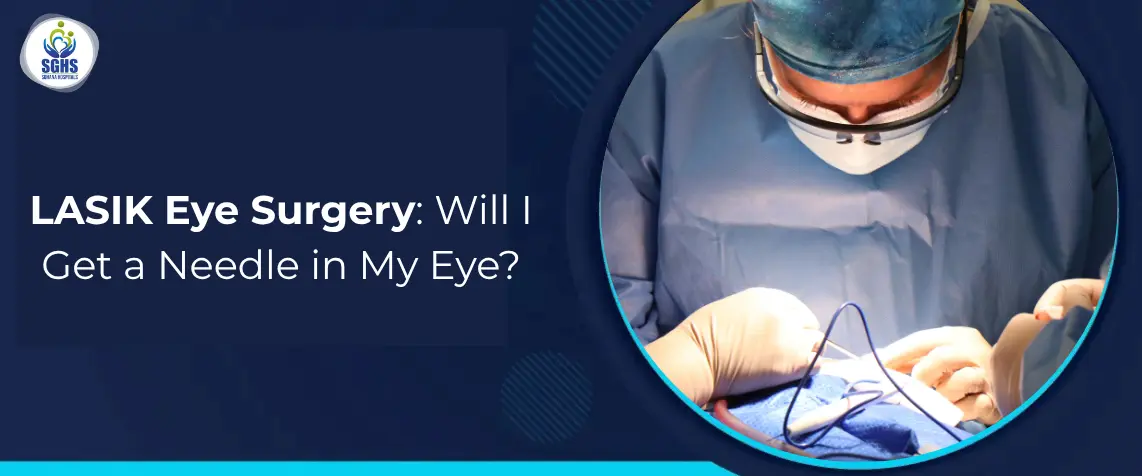
Let us put your worries to rest – No, you will not have any needle come in contact with your eye during your LASIK eye surgery.
Anesthesia is administered via numbing eye drops only. The entire surgical process does not employ any needles or injections. Read this blog to learn more about the kind of anaesthesia that’s actually used, why the misconception
is more common than you might think, and what you will actually feel once you’re on your LASIK surgeon’s table.
Read more on:
ToggleAnaesthesia Used in LASIK Eye Surgery
All refractive surgeries at Sohana Hospital (LASIK or laser) use only numbing eye drops for the procedure. These drops are administered topically on the surface of the eye. These drops block pain receptors in the eye, making the process completely painless.
Patients typically describe their surgical experience as ‘slight pressure’ or ‘a sensation of tightness’ in their eye, but no sharp pain or discomfort.
So just to clarify – there’s no injection involved in the procedure, no needle that touches your eye, and no numbing shot of any kind. The fear of needles during LASIK is understandable, but it’s far from reality. So, if you’ve been delaying or postponing your LASIK surgery because of this fear, rest assured that the procedure is completely injection & needle-free.
👉 Also read: LASIK Surgery: Procedure, Benefits, Cost, Recovery & Eligibility
How Common is Needle Fear?
Now, the LASIK-needle fear is not some irrational apprehension that’s surfaced out of the blue. It comes from a real, albeit misplaced, context. There are other eye procedures that do involve the use of needles and injections.
Certain types of cataract surgery, vitrectomy, diabetic eye diseases, etc., employ injections. Therefore, if someone’s only point of reference is hearsay about the umbrella term “eye surgery” and they assume the same applies to LASIK eye surgery, too, it’s understandable why they might be nervous.
| 💡 INTERESTING FACT: A global survey conducted in 2022 revealed that out of 2,098 total adult participants, 63.2% reported experiencing needle fear. (via NIH)[1] |
What Actually Happens During LASIK Surgery?
Once your eye’s surface has been numbed, you will not feel any pain. However, that’s not to say that you won’t feel any sensation at all. It’s important to go into surgery knowing what to expect, so you can make an informed decision and feel confident with your choice.
Your eyes are held open using a small eyelid holder, also known as a speculum – it keeps your eyes open, so you do not need to worry about accidental blinking. Patients typically describe this sensation as a mild stretch or squeeze around the eyelid, nothing major.
The laser application is often described as feeling slight pressure, as opposed to sharp pain or discomfort. Besides, most modern LASIK procedures are generally brief, with a laser time of only a few seconds (per eye) – so your eyes are not exposed to the ‘pressure sensation’ for too long anyway.
Once your cornea has been reshaped, the eye speculum is gently removed.
Addressing the Opposite
Another prevalent, if not common, misconception some patients have is whether they’ll be put under general anaesthesia for the procedure. We want to clear this by stating: no, you will not be given general anaesthesia for your LASIK eye surgery.
This is because you need to stay awake and fixate on a light during the procedure – your focus and cooperation can have a direct impact on the visual results.
Conclusion
If you have any other concerns regarding LASIK/laser specs removal surgery, book a consultation with the best LASIK surgeons at Sohana Hospital today. Our experts evaluate your unique eye profile and only advise you on the most suitable treatment option for your eyes.
Sohana Hospital boasts all the latest specs removal technologies – Tricity’s 1st & ONLY Complete Refractive Suite:
- Wavelight Plus InnovEyes: World’s most advanced & latest AI+3D ray-tracing LASIK. Maps 1,00,000 points on the eye to create a Digital Eye Twin and deliver 100% personalised vision correction. It corrects refractive errors like myopia and astigmatism, along with higher-order optical aberrations.
- SMILE Pro: SMILE Pro is the world’s 1st AI+robotic laser specs removal surgery. Bladeless, flapless, and completely painless – the surgery takes just 9 seconds (per eye)
- Contoura Vision: This is a topography-guided customised specs removal surgery. It maps over 22,000 points on the eye and corrects hyperopia, astigmatism, or myopia – along with corneal aberrations.
- Femto LASIK: A bladeless LASIK alternative, this surgery uses a femtosecond laser to make the corneal flap. Then the cornea is reshaped using an excimer laser to correct your vision.
- PRK: PRK, or Photorefractive Keratectomy, is a no-touch & no-flap specs removal treatment suitable for people with thin corneas. It doesn’t involve a flap or an incision; it just dissolves the topmost layer of the cornea to reshape the underlying tissue. This is an ideal option for government job aspirants.
- PRESBYOND Laser Blended Vision: This is an advanced specs removal option for people aged 40 and above – dealing with presbyopia. It provides clear distance, intermediate, and far vision by creating a ‘blend zone’, overlapping vision in both eyes (one for distant, one for near).
- ICL: If you have thin corneas, high myopia, or dry eyes, you may not be an ideal candidate for LASIK. This is when ICL or Implantable Collamer Lens Surgery, comes into play. It involves placing a customised biocompatible lens in front of the natural lens to facilitate clear vision. It is a reversible & reliable means of vision correction.
- RLE: Refractive Lens Exchange Surgery involves replacing your natural eye lens with an artificial biocompatible lens. Ideal for people above the age of 40, the procedure employs a lens implant completely customised to your refractive error. Since the natural lens is replaced with an artificial one, the risk of developing cataracts in the future is eliminated, too.
Reference Sources:
- National Institutes of Health. Prevalence, causes, impacts, and management of needle phobia: An international survey of a general adult population. https://pmc.ncbi.nlm.nih.gov/articles/PMC9678288/#sec006:~:text=A%20total%20of%202%2C098%20participants%20completed%20the%20survey%20and%2063.2%25%20(n%20%3D%201%2C325)%20reported%20experiencing%20needle%20fear. – Nov 21, 2022